Baby Dragon
My Father's DragonBaby Dragon is a young dragon whose capture turns him into Wild Island’s unwilling river ferry. Found injured and unable to fly back to his cloud, he is tied to a stake and made to carry passengers across the island’s river. Old Alley Cat becomes his secret friend and tells Elmer Elevator about his confinement; Elmer’s rescue changes Baby Dragon’s course from coerced labor to a chosen escape.
Identity and Arrival
About four months before Old Alley Cat arrived on Wild Island, Baby Dragon fell from a low-flying cloud onto the bank of a wide, muddy river. He was too young to fly well and had badly bruised one wing, leaving him unable to return to his cloud. The animals soon found him. Because they had long disliked going around the river to reach the other side of the island, they treated the stranded dragon as the solution to a problem of their own: they tied a large rope around his neck and waited for his wing to heal.
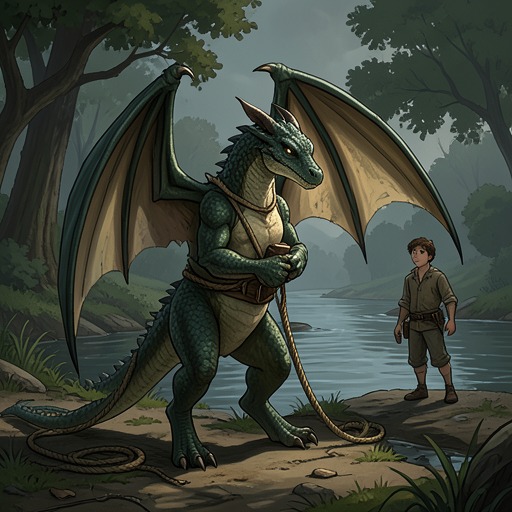
The cat describes Baby Dragon as about the size of a large black bear, with a long tail, yellow and blue stripes, a red horn, red eyes, bright red undersides of his feet, and gold-colored wings. She supposes he may have grown since she left, but the story does not establish his later size. His distinctive appearance sets him apart from the island’s other animals, while his youth and injured wing make clear how vulnerable he is when they capture him.
Captivity and Forced Labor
Once his wing healed, the animals trained Baby Dragon to carry passengers across the river. The crossing served the animals’ convenience: walking around the river had made visits difficult and mail deliveries slow, especially during the Christmas rush. But the arrangement did not give Baby Dragon a choice. According to Old Alley Cat, he was worked all day and sometimes all night, loaded beyond what he could comfortably carry, and beaten or had his wings twisted when he complained.
His confinement was built into the ferry system. He remained tied to a stake by a rope long enough to let him cross the river, but not to leave. Old Alley Cat describes the rope as exceptionally tough and knotted so thoroughly that untying it might take days. At the riverbank, Elmer later finds a high flagpole with a rope running over to the opposite side, through a loop, and down around a crank. Its sign tells anyone wishing to summon the dragon to yank the crank and report disorderly conduct to Gorilla. The mechanism makes the coercion visible: if Baby Dragon was on the other side, Gorilla could crank him back or choke him; if he was here, Gorilla could twist his wings until pain forced him to fly across.
Friendship with Old Alley Cat
Old Alley Cat is Baby Dragon’s friend during his captivity. She used to hide in the bushes and talk with him when nobody else was around. The Crocodiles, she says, are his only other companions, greeting him about once a week when they remember. This sparse contact contrasts with the animals’ constant use of him as a means of transportation: he is essential to their routine but largely isolated from companionship.
Before leaving Wild Island, Old Alley Cat promised that she would try to help him someday, although she could not see how. Her promise links the account of his suffering to Elmer’s later arrival. When Elmer asks about airplanes, the cat turns the conversation toward the possibility of rescuing Baby Dragon and riding him, provided he treats him kindly. The rescue plan thus begins with the cat’s testimony and friendship, not with the animals’ account of their ferry or any concern for the captive dragon.
Rescue and Release
When Elmer reaches the river, he understands that calling Baby Dragon across would alert Gorilla. He considers climbing the flagpole and crossing hand over hand along the rope, despite the height and the dangers that might be in the muddy water below. Instead, the rescue becomes a race against the approaching animals. Baby Dragon realizes that Elmer has come for him, runs out of the bushes, and jumps up and down, calling for him and warning that the Wild Boars are crossing on the Crocodiles.
Elmer runs to Baby Dragon with a sharp jackknife and begins sawing through the rope, urging him to stand still. The delay is dangerous: both Wild Boars, all Seven Tigers, two Lion, Rhinoceros, Gorilla, and the screeching monkeys are coming across, and a great deal of rope remains to be cut. The immediate threat is interrupted when the Crocodiles, each occupied with a Pink lollipop, turn away from the bank and swim downriver one after another. The pursuing animals are carried along on their backs, yelling and getting their feet wet. The distraction gives Elmer time to finish cutting the rope.
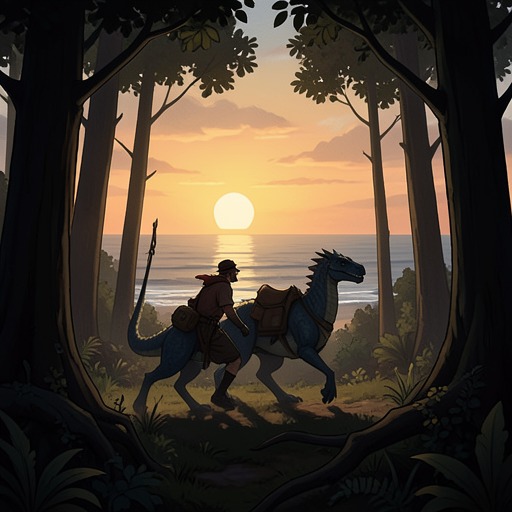
Freed at last, Baby Dragon races in circles and tries to turn a somersault; he is described as overwhelmingly excited. Elmer climbs onto his back, and Baby Dragon asks where they will go. Their exchange marks a decisive change in his role: the dragon who had been summoned and driven by a crank can now take part in choosing the journey. Elmer and Baby Dragon fly toward the shores of Tangerina, planning to spend the night on the beach and begin the long journey home the next day.
Escape and Significance
As they fly above the dark jungle and muddy river, the animals bellow below and the Crocodiles continue licking their Pink lollipops. The absurd sight reverses the island’s established arrangement: the creatures who used Baby Dragon to solve their crossing problem are now being carried away from the bank, while he travels freely with someone who has freed him. The Crocodiles’ appetite and moodiness, previously part of the reason the animals did not rely on them, become the accidental means of escape.
Over the Ocean Rocks, a tiny voice cries that the animals need their dragon. Baby Dragon and Elmer do not turn back; the story says nothing could make them return to Wild Island. His ending is therefore not a reconciliation with the system that confined him or a return to his cloud, but an escape from the island with a new companion and the prospect of a long journey home. The contrast between the rope that restricted his movement and flight that carries him away gives his release its force: Baby Dragon is no longer the animals’ transport, but a participant in his own departure.